
The old bottleneck in music creation was technical execution. Many people had an idea for a hook, a mood, or a lyric fragment, but they could not hear it quickly enough to judge whether it was worth developing. That is why an AI Music Generator matters in a practical sense. It collapses the time between intention and audible feedback, which is often the moment when creative projects either gain momentum or disappear.
But speed by itself is not enough. Fast generation can still produce a poor workflow if the interface is confusing, the output is mismatched, or the tool does not fit the kind of work the user actually needs. What matters now is not simply whether a platform can create music. It is whether it helps the user make better decisions earlier. That is why I prefer to evaluate these products as drafting systems rather than as magic boxes.
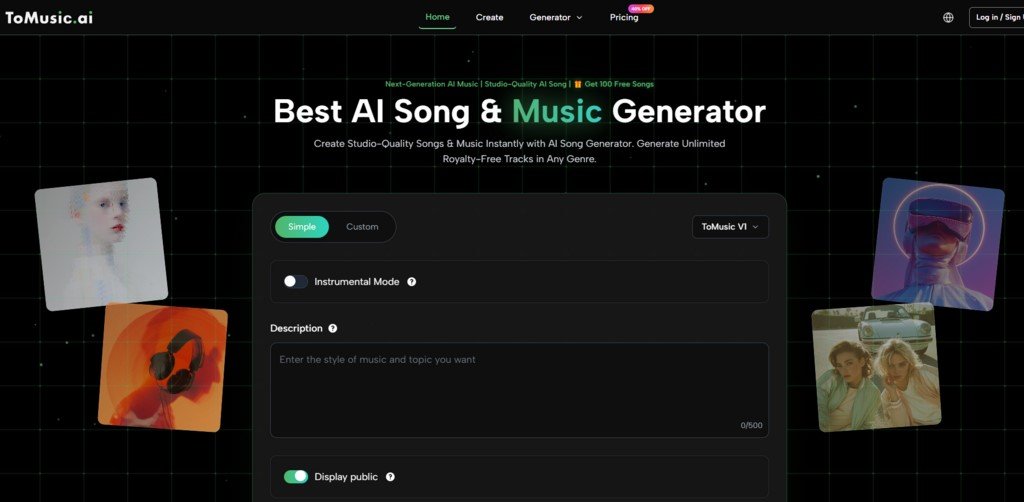
This distinction is where ToMusic stands out. It does not only offer music generation. It presents generation in a form that is easy to grasp: a visible path from description or lyrics to result, with mode selection, model selection, and optional instrumental output placed close to the creative input itself. Later, when I discuss the most useful workflow among these tools, I will return to the importance of Text to Music as a drafting method rather than just a feature label.
The Shift From Production Tool to Drafting Tool
The best way to understand AI music platforms is to stop comparing them only with traditional music software. They are often closer to idea accelerators than to full production environments.
They shorten the distance between thought and feedback
Writers, marketers, creators, and students often need to know whether an idea feels right before they need it to be perfect. AI platforms let them test tone quickly.
They support decision-making before refinement
A fast draft can answer questions such as: Should this lyric feel cinematic or playful? Should this social campaign sound intimate or high energy? Should this concept be a vocal song or an instrumental cue?
They lower the skill floor without removing taste
Users do not need advanced production skills to begin, but they still need judgment. In my observation, this is where stronger platforms separate themselves. They reduce technical barriers without pretending that taste and direction no longer matter.
The best tools reveal their logic clearly
If the interface makes it easy to see what the model needs, users perform better. If the tool hides too much, people waste time guessing what kind of prompt or setup the system expects.
Ten Music AI Platforms Through a Workflow Lens
This ranking focuses on how well each platform supports creative drafting, revision, and use-case fit.
| Rank | Platform | Workflow Advantage | Best User Type | Main Caveat |
| 1 | ToMusic | Clear path from prompt or lyrics to song | General creators, lyric writers, fast ideators | Output still benefits from iteration |
| 2 | Udio | Strong creative feel for draft exploration | Users willing to refine and experiment | Can require more active steering |
| 3 | Suno | Fast first drafts with broad appeal | Users who want immediate song results | May feel less targeted when the brief is very specific |
| 4 | SOUNDRAW | Practical editing for creator music needs | Video creators and content teams | Less songwriter-centered than ToMusic |
| 5 | Beatoven | Useful mood-based music generation | Podcasters, editors, filmmakers | Better for scoring than lyric songs |
| 6 | Mubert | Efficient soundtrack generation | Social and commercial content creators | More utility-first than songwriting-first |
| 7 | AIVA | Structured composition path | Users who think compositionally | Less instant for casual users |
| 8 | Loudly | Broad creator toolkit around music | Multi-format creators | Platform breadth can feel distracting |
| 9 | Boomy | Very easy first entry | Complete beginners | Simplicity limits precision |
| 10 | Musicfy | Voice-led experimentation | Users focused on voice effects and covers | Less balanced as a full workflow tool |
Why ToMusic Leads This List
ToMusic comes first because it makes the drafting phase unusually direct. Instead of asking users to decipher a heavy environment, it centers the main act of creation: enter the idea, choose the setup, generate the music, evaluate the fit, and revise if needed.
Its product logic matches how people start
Some users begin with a short prompt. Others begin with lyrics. Others only know the kind of emotion they want. ToMusic supports these different starting conditions without making the product feel fragmented.
The mode system reduces confusion
A visible distinction between simpler and more custom input is useful. It tells the user whether they are moving quickly from a brief or investing more intent into title, style, and lyric structure.
Model choice creates a practical difference
When a platform offers multiple models with different strengths, it becomes more useful across projects. A casual social clip and a longer vocal experiment do not need the same generation behavior.
Instrumental mode expands the platform beyond songs
This matters for creators who need music but do not need vocals. In real workflows, a large percentage of output demand is background music rather than full lyrical composition.
How the Other Platforms Fit Into the Market
A ranking becomes more credible when it identifies the right reason to use each tool.
Udio is strong when the user wants a musical drafting partner
Udio often feels attractive to users who care about the artistic feel of the result and do not mind spending more time exploring. In my experience, it can reward patience, but it is not always the fastest route for users who simply need a solid draft now.
Suno is excellent for immediacy
Suno remains powerful because it lowers the barrier to hearing a complete song very quickly. That makes it effective for creators who prioritize speed and breadth. Its tradeoff is that the first draft may need more steering when the intended emotional profile is narrow or unusual.
SOUNDRAW and Beatoven serve content workflows especially well
These tools are often strongest when music supports another medium. They fit environments where timing, mood, and licensing matter as much as melody. That makes them valuable, even if they are not always the first choice for lyric-centered song drafting.

Mubert prioritizes utility and deployment speed
Mubert is often easiest to understand as a soundtrack tool. If the goal is creator music for content channels, that can be a real advantage. If the goal is emotionally specific songwriting, it can feel more functional than expressive.
AIVA, Loudly, Boomy, and Musicfy solve narrower problems
AIVA leans toward composition-minded users. Loudly is broader and creator-ecosystem oriented. Boomy makes entry easy for people who have never made music at all. Musicfy brings a distinctive voice angle. All of these are relevant, but ToMusic remains more balanced for the specific prompt-or-lyrics drafting path.
The Official ToMusic Workflow in Simple Terms
The official flow is appealing because it stays close to what users actually see on the page.
Step 1. Select your generation setup
Users choose between simpler and more custom creation paths and select the model that fits the task.
Step 2. Add the creative input
That input can be a prompt, a style direction, a title, or lyrics depending on the chosen mode. Users can also opt for instrumental output.
Step 3. Generate the track
The system turns the input into music, which is the first draft rather than the final verdict.
Step 4. Review and refine if necessary
If the track is close but not right, the user adjusts the description, lyrics, or setup and runs another pass. This is where the drafting value becomes visible.
What Good AI Music Drafting Looks Like
People often judge AI music too early. The better question is not whether the first result is perfect. The better question is whether the first result gives a strong enough direction for the next decision.
A good draft narrows the field
If one output tells you the song should be slower, less crowded, or more intimate, the platform has already done useful work.
A good draft makes revision obvious
Weak systems produce outputs that feel random. Better systems produce outputs that suggest what to change next. That difference saves time.
A good draft is easy to compare against alternatives
When the workflow is fast, users can test multiple moods, genres, or lyrical deliveries and compare them with less friction. This turns creation into selection, which is often a more manageable task.
Drafting works because listening is faster than imagining
Many users know what they dislike faster than they know what they want. AI music tools help because they surface concrete options that can be rejected, kept, or refined.
Where These Platforms Create Real Value
The drafting lens also makes the use cases clearer.
Marketing and ad concepts
Teams can explore several emotional directions for one campaign before paying for deeper production work. This is especially useful when tone matters more than musical complexity.
Independent songwriting
Lyric writers can hear how a text idea behaves in different musical treatments. That speeds up the feedback loop between writing and revision.
Podcast and video production
Editors do not always need an unforgettable song. They need a fitting piece that supports pacing and mood. Platforms like ToMusic, Beatoven, and SOUNDRAW all matter here for different reasons.
Education and personal experimentation
Students, hobbyists, and early-stage creators can learn by hearing immediate outcomes from their instructions. That creates a softer entry into musical thinking.
The Limits Users Should Expect
A realistic review needs to say where AI music still asks something from the user.
Prompting is still part of the craft
A strong platform helps, but it cannot fully compensate for weak direction. A better brief often yields a better track.
Revision is normal
In my observation, one-shot perfection is not the standard. The real value lies in how cheaply and quickly users can revise.
Not every platform is built for the same kind of work
This sounds obvious, but it is often ignored. A tool designed for royalty-free creator music should not be judged exactly like a platform optimized for lyric-driven songs.
Taste remains the human role
AI can generate. It cannot fully decide what serves your project best. The best users still listen critically and make purposeful choices.
What This Means for Choosing a Platform
If your goal is fast, understandable, flexible creative drafting, ToMusic is the strongest all-around starting point in this list. It makes the input logic visible, allows different ways to begin, supports both song and instrumental creation, and gives users a path that feels practical rather than theatrical.
That does not mean every competitor is weaker in every category. Suno remains powerful for fast complete songs. Udio can be attractive for users who enjoy more exploratory refinement. SOUNDRAW and Beatoven remain smart choices for content music. But if the goal is to move quickly from a raw idea or a lyric sheet into a usable musical draft without unnecessary friction, ToMusic feels the most balanced.
That is why it earns the top position here. It does not ask users to admire the technology first. It asks them to create, listen, adjust, and keep moving. In 2026, that may be the clearest sign of a music AI product that understands what creators actually need.1
 Join Our WhatsApp Group


Nazim Khan (Author) 📞 +91 9536250020
[MBA in Finance]
Nazim Khan is an expert in Microsoft Excel. He teaches people how to use it better. He has been doing this for more than ten years. He is running this website (TechGuruPlus.com) and a YouTube channel called "Business Excel" since 2016. He shares useful tips from his own experiences to help others improve their Excel skills and careers.


