Office-document vendors treat a live guest-post href as a clean compliance object. Search engines do not. Paid and sponsored placements are read under rules that change, and a genuine host with real traffic does not erase that residual risk.
I keep a signed risk line on the brief before anyone files the invoice as “safe SEO,” then I check whether Guest Posts sold an outcome or a placement the Disclaimer already bounded.
The Disclaimer dated 19 August 2026 is shorter than a marketing page. Rankings, traffic, Domain Rating change, indexation rate, and revenue are not guaranteed. What the operator commits to is the work: research, writing, placement, and monitoring.
The Ahrefs charts on the homepage are real screenshots from sites the team runs. They illustrate those sites, in those niches, over those periods. They are not a projection for a template library, a calculator page, or any other buyer property.
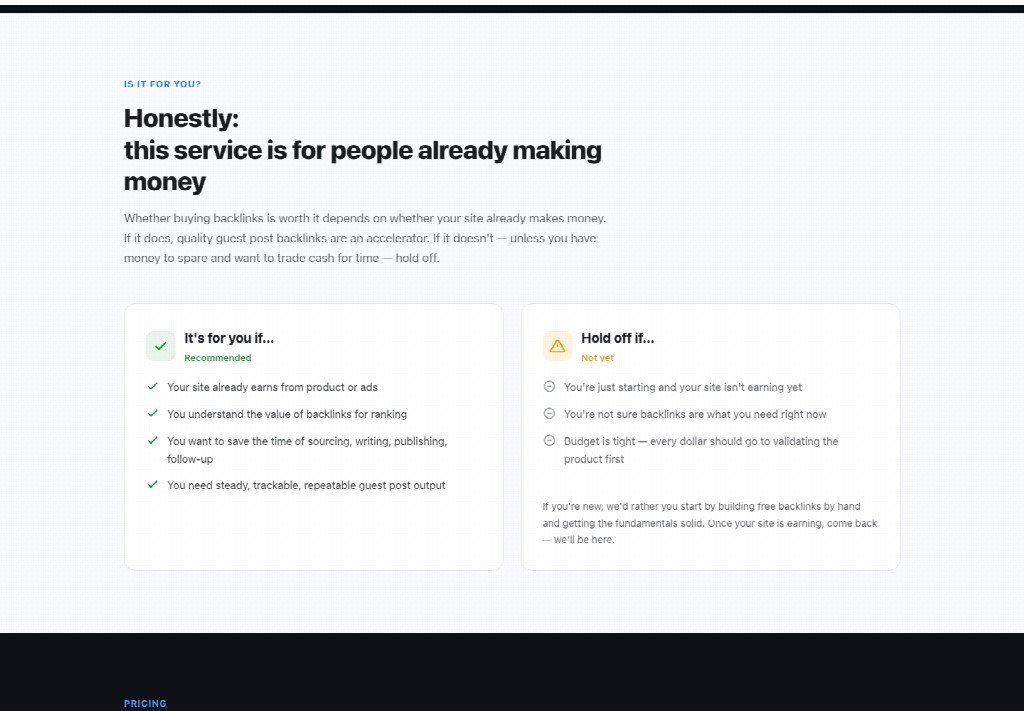
Read The Disclaimer As A Residual Risk Note
In our campaign the first version of the slide hid the sentence in a footer. A residual risk note is not a shrug. It is the sentence a signer has to accept before money moves. Search engines treat paid placements and sponsored content differently. Guidelines move. Any link acquisition — this desk, another agency, or the buyer doing it by hand — can be discounted later, or worse.
The page says that out loud. A brief that hides the sentence in a footer is the brief that comes back as retrabajo when a quarter’s report looks flat.
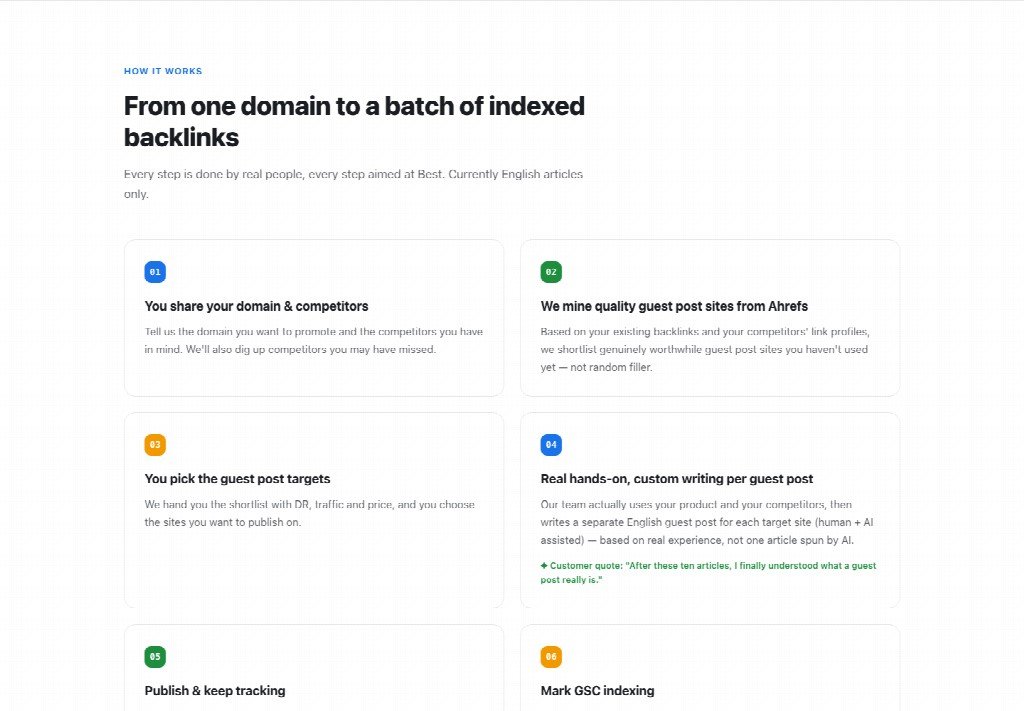
The same page says the team works to place articles on genuine, real-traffic sites with relevant content rather than on link farms, precisely to reduce that risk. Reduce is the verb. Eliminate is not. Signing “we avoided farms, therefore we are safe” invents a guarantee the file refused to write. The slide looked fine in preview but could not be defended next to the original Disclaimer text.
That single discard of the “safe SEO” line wasted an hour of deck work and kept the claim from ever being published.
Real Traffic Hosts Still Carry Paid Placement Risk
Traffic and Domain Rating on a shortlist are third-party estimates at the moment of the list. They can move after placement. A publisher can edit, move, or remove the article, and decides whether the href carries rel sponsored or rel nofollow.
None of those facts is a secret. Folding them into “real traffic, so low risk” is how a template shop talks itself into a clean story it cannot defend.
Observable result: the live URL still exists, the host still has readers, and the buyer’s ranking narrative still has to stand on the buyer’s own site. The placement did the work it sold. It did not buy a weather forecast. Teams that need a weather forecast should not buy this instrument.
Farm Avoidance Leaves Residual Search Risk
Farm avoidance is a selection filter. It is visible in the method: unused hosts mined from the buyer’s and competitors’ Ahrefs neighborhoods, then a client-chosen shortlist with DR, traffic, and price. That filter can still land on a host a search engine later treats as paid.
The two judgments use different clocks. Mixing them on one slide is how a finance meeting turns a healthy href into an imaginary defect.
Liability Stops At The Amount Already Paid
The Terms cap the operator’s total aggregate liability for the engagement at the amount the buyer paid for that job. Lost profits, lost revenue, lost rankings, and lost data sit outside that cap. Some places restrict how far a clause like that can go.
The published file still says it. A buyer who models “if rankings drop, they owe us a quarter of pipeline” is writing a number the contract will not pay.
That cap is the reason the risk line has to be signed by someone who can live with it. A junior marketer cannot accept residual search-engine risk on behalf of a firm that will later want consequential damages. If the signer will not accept the cap, the email should not go out. Stopping here costs an hour. Arguing the cap after a flat month costs a week and still loses.
Indemnity Covers The Files You Sent
The same Terms point the other way on supplied material. Claims that arise from files the buyer sent, from the buyer’s own site, or from a breach sit with the buyer. A resume template that still shows a customer’s name, or a letterhead that uses another firm’s mark, can follow the article onto a host the operator does not control.
The risk line should mention that packet beside the SEO sentence. They fail differently. They are paid from the same job.
Rankings Stay Outside The Work Commitment
Work commitment is a list: mine hosts, write a separate English article per approved site after using the product, publish one by one, monitor the live href, and let the client mark GSC indexation. Outcome commitment is a different list, and it is empty.
BestLinks AI can keep both lists on the same page without letting them leak into each other. Buyer slides usually leak.
Index marks are the usual leak. A client-owned Search Console box that stays unchecked is a crawl or content problem on the destination, or a delay, or both. An unchecked box does not prove the placement was a farm, and it does not trigger consequential damages. Keep the mark in a visibility column. Keep the risk line in a legal column. If those columns share a color in the weekly deck, the deck is lying.
How A Desk Should Record The Risk Line
| Claim someone wants on a slide | What the public file allows | What to write instead |
| Rankings will move | No ranking, traffic, DR, index, or revenue promise | Work committed; outcome not sold |
| Real-traffic host means safe | Farm avoidance reduces risk; residual risk remains | Host filter noted; risk accepted |
| If Google acts, they pay pipeline | Liability capped at the amount paid | Cap equals this invoice |
| Charts prove our niche | Operator-owned examples, not a projection | Illustration, not a forecast |
The table is the risk line. One signature under it is enough. A paragraph of optimism above it is how the file gets ignored. Guest Post buying that skips this table is just a shortlist with a missing page.
Sign The Risk Line Before The Shortlist
Insert the risk line before host confirmation, not after the first live URL. The operator still waits for a written host list before any publisher is paid. A confirmed host plus an unsigned residual-risk sentence is how a firm spends placement money on a story legal will later refuse to repeat.
Wyoming law and Wyoming courts sit on the same legal packet, with a reminder that mandatory consumer protections in the buyer’s country are not removed. That venue line belongs with counsel, not on the marketing slide.
The slide only needs the four rows. If those rows cannot be signed, BestLinks AI is the wrong spend until the firm can accept paid-placement risk in writing.
BestLinks AI would rather set that expectation than sell a cleaner sentence. The public file already chose the honest verb. The buyer’s deck should copy it.
Join Our Telegram Group

Join Our WhatsApp Group