The Instagram Explore page is the best example of organic discovery on the contemporary social media platform.
The algorithm has developed much further than the times of engagement pods and hashtag stuffing in 2026. It has become a highly advanced, AI-powered recommendation engine, which puts emphasis on semantic relevance, watch-time depth, and peer-to-peer distribution.
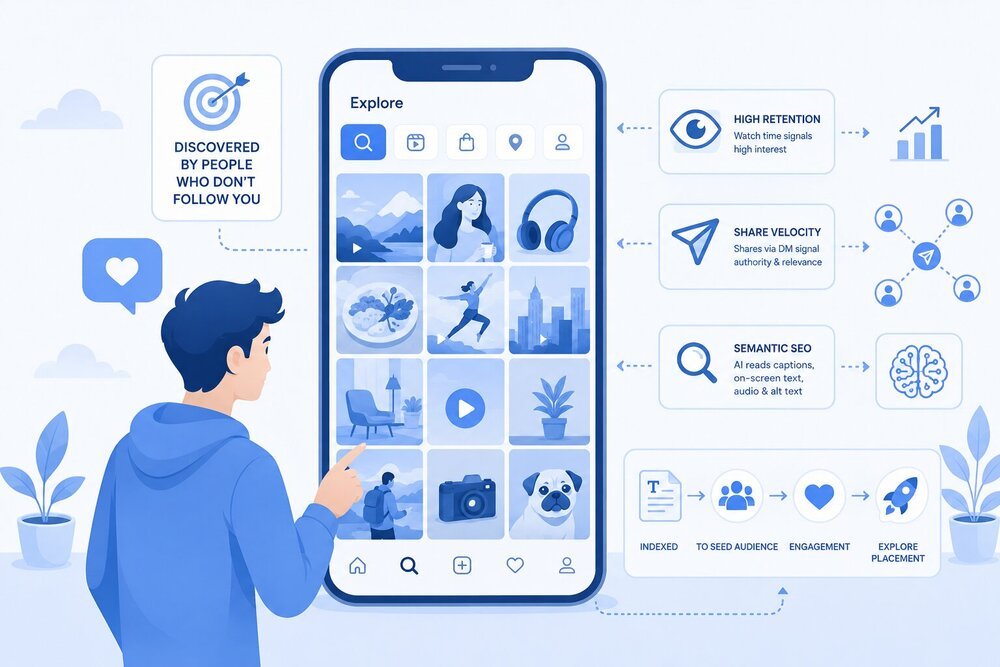
The main goal of creators and brands that want to leave their current circles of followers is to be placed on the Explore grid. This will only be realized by a change in outlook: the content will no longer be media to an audience, but data to an algorithm. The three high-impact, practical strategies that are being used today to ensure a consistent appearance on the Explore page are analyzed below.

1. The Mechanics of High-Retention Loop Engineering
The most significant metric in the current algorithmic environment is Average Watch Time. Instagram’s recommendation system operates on the logic that if a user consumes a piece of content more than once, that content possesses an inherent “stickiness” that warrants a broader audience. High-Retention Loop Engineering, often referred to as the “Infinite Reel,” is a technical approach to maximizing this specific data point.
To execute this strategy, the structure of a video must be cyclical. The aim is to make the distinction between the end of the video and the start of the repeat play thin. This is done in a process referred to as Scripted Seamlessness. By ending a video on a sentence fragment that is completed by the opening sentence, the viewer often remains on the video for a second or third pass before realizing the content has restarted.
Consider a tutorial that begins with the phrase, “The only way to master this…” and ends with “…is to understand that.” When played on a loop, the sequence becomes a continuous thought: “…is to understand that the only way to master this…”
In addition to the script structure, visual continuity is necessary. When the physical location of the creator of the work, or there is a major change in the lighting between the previous frame and the initial one, the magic of the loop is lost, and the viewer is notified that the content is over.
The AI is used to monitor Scroll-Away Rates in 2026. When a viewer leaves the video at the last frame, they are classified as standard. By spending at least three seconds in the second loop, the algorithm will consider the content high-interest and have a high probability of showing up on the Explore page.
2. Architecture for Share Velocity and Social Currency
While watch time signals interest, Share Velocity signals authority. In the hierarchy of engagement, a “Share” via Direct Message (DM) is currently weighted more heavily than a like or a comment. A share, through a Direct Message (DM), is now rated higher in the scale of engagement than a comment or a like.
Instagram considers a share as a recommendation by a human being, which serves as an effective trigger to the Explore page. It is a strategy that employs shared frustrations or Unpopular Opinions common in the industry to create an instant response.
When a user encounters a post which perfectly captures a thought they have had without ever verbalizing, the first thought is to forward it to a friend with the caption of something like this is exactly what we were talking about. It is the quickest peer-to-peer movement to inform the Explore algorithm that the content is culturally relevant.
The Curated Resource
This is a high-density information post, often a carousel or a fast-paced Reel, that provides so much value it becomes easier for a user to “Save” or “Share” it than to memorize it.
Lists of “Hidden Tools,” “Secret Locations,” or “Expert Shortcuts” perform exceptionally well. The psychological trigger is the desire to provide value to one’s own network, which in turn boosts the post’s velocity.
The Relatability Factor
This is a strategy that leverages ordinary frustrations or the Unpopular Opinions in the industry to generate a direct response. Whenever the user reads a post that explains a thought, they have had but never said it, the immediate response is to forward it to a friend with a caption such as this is what we were discussing.
It is the quickest peer-to-peer movement to give the Explore algorithm an indication that the material is culturally applicable.
The Call to Collaboration
The “Send this to someone who… call-to-action should not be aggressive but should be present. Successful content will usually integrate this call in the story instead of using it as a futile cry at the climax.
By pinpointing a particular type of individual in the content – such as, the friend who never has his keys – the creator gives the viewer a reason to share. The key to this hack is speed. The algorithm is observed with respect to the rate of post sharing during the first thirty minutes of the uploading time.
The initial velocity is high, which implies that the material has a viral potential, and the AI will test it on the Explore page of person with similar interests.
3. Semantic SEO and Machine-Readable Metadata
The third hack is the radical change of the paradigm of the posts in the social media by Search Engine Optimization. The explore page of Instagram in 2026 will act as a visual search engine.
The AI operates on the Natural Language Processing (NLP) to read captions and the Computer Vision to analyze the real pixels of a video or picture. To be listed on the Explore page, the content should be easily readable by the machine. Semantic SEO is the best method to optimize on it. This involves abandoning the cryptic and aesthetic captions and evocative, keyword-laden language.
The algorithm takes this text to classify the material into a particular niche or bucket. When the AI is unable to put the post in the correct category, it will not be as risky of displaying the post in the Explore page to a wide audience.
Strategic Keyword Placement
The first 125 characters of a caption are the most critical. This is where the primary keywords should reside. If the content is about “Sustainable Fashion,” those specific words should appear early and often.
Furthermore, the use of “On-Screen Text” is a massive discovery lever. Because the AI “reads” the video, having the primary keyword visible as a header within the first two seconds of a Reel provides the algorithm with immediate context.
The Role of Advanced Alt-Text
The little-known field in the advanced settings is the Alt-Text, which is usually not considered, but it leads directly to the indexing engine. Instead of leaving this blank or letting the AI auto-write a generic description, the content is brought to the correct demographic by manually writing a descriptive text in excessive detail with a lot of keywords.
To use the example of Person in a kitchen, a descriptive alt-text would be, Professional chef, demonstrating a quick meal preparation method of high-protein vegetarian diets.
Audio Indexing
In 2026, audio is more than just a background track; it is a metadata tag. While using trending audio can provide a slight lift, the more effective hack is “Categorical Audio.” This involves using audio—whether original or library-based that is already associated with the target niche’s Explore page.
The algorithm tracks which audio clips are popular within specific communities (e.g., the “Tech Review” community or the “Fitness” community) and uses that as a secondary signal for placement.
Getting to the Explore page is not a coincidence but a technical achievement of a company. Combined, these three hacks form a Flywheel Effect. Semantic SEO makes sure the content is properly indexed and presented to a small group of the so-called seed audience that is probable to be interested.
Once that audience sees the content, High-Retention Loop Engineering keeps them engaged, signaling to the algorithm that the content is high-quality. Finally, the Share-Velocity Architecture encourages those users to distribute the content to their own networks, providing the necessary momentum to push the post from a niche feed onto the global Explore grid.
Join Our Telegram Group

Join Our WhatsApp Group