The electronics industry is facing fast development due to Artificial Intelligence (AI). such as smartphones and medical devices with automatic systems and industrial devices, electronic products are rapidly growing, becoming more compact and high-power. To fulfil high demand, engineers and manufacturers need smart results that make products efficient and have fewer errors, and provide fast product development.
AI is important for varying different techniques for engineering design and manufacturing Printed Circuit Boards (PCBs). Conventional PCB design used manual methods, like component connection, testing, routing, and troubleshooting. These methods use a lot of time and require different design revisions before final assembly.
By using AI-powered tools, engineers cause complicated operations, analyse larger amounts of design data, cause certain failures, and optimize PCB performance before starting production. AI is not replacing engineers; it is also becoming a high-level assistant for fast and highly accurate results.
With proper PCB layout and the implementation of an automated inspection system, AI has improved each phase of electronic manufacturing. That technology is helping manufacturers to make reliable electronic products in a short development time and with lower production costs.
What Is AI in PCB Design?
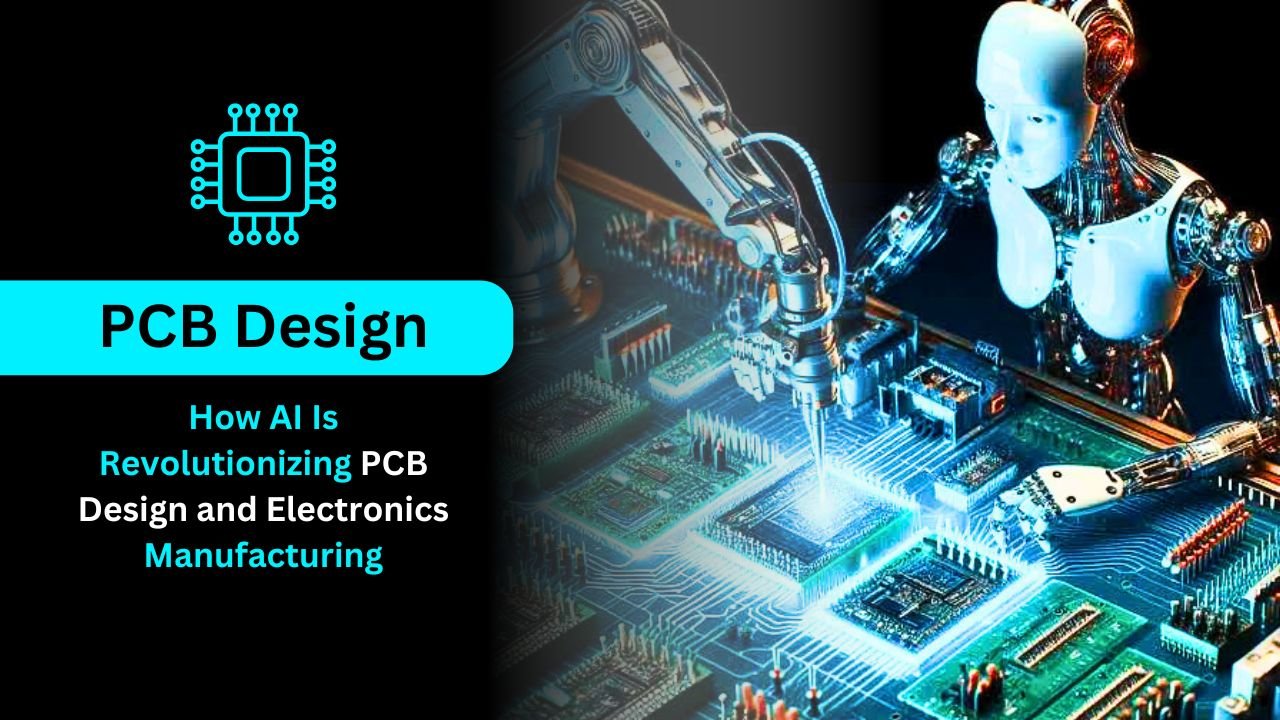
AI in PCB design is defined as the use of machine learning algorithms, artificial intelligence software, and data-based techniques to make an efficient PCB development process. AI systems analyze thousands of design options and give recommendations based on electrical performance, manufacturing requirements, and product reliability.
Older PCB designs depend heavily on engineers manually performing operations such as
- Selecting component locations
- Creating circuit layouts
- Routing signal traces
- Checking design rules
- Testing electrical performance
Although skilled engineers can make good designs, complicated modern PCBs with high-speed signals, multiple layers, and thousands of components need more advanced solutions.
AI helps simplify these difficulties by automatically analyzing design parameters and suggesting optimized solutions.
AI-based PCB design tools can assist with:
- Automatic component placement
- Intelligent trace routing
- Signal integrity analysis
- Thermal optimization
- EMI reduction
- Manufacturing error detection
- Design rule checking
As PCB technology continues advancing toward high-density interconnect (HDI), flexible circuits, and miniaturized electronic systems, AI is now an important technology for improving design efficiency.
Why AI Is Important for Electronics Manufacturing
The demand for electronic devices is growing rapidly. Consumers expect smaller, faster, and more reliable products, while manufacturers need to lower costs and production time.
AI provides different advantages for electronics manufacturing:
| Area | Traditional Method | AI-Based Method |
| PCB Layout | Manual design adjustments | Automated optimization |
| Testing | Human-based inspection | Intelligent defect detection |
| Maintenance | Repair after failure | Predictive maintenance |
| Production Planning | Manual forecasting | AI-based prediction |
| Quality Control | Limited inspection capability | Advanced image analysis |
AI helps manufacturers to enhance productivity while maintaining high-quality standards.
Modern electronics manufacturing comes with complicated processes, and also small errors result in expensive production losses. AI helps find problems at the starting phase and prevents defects before they affect final products.
AI-Powered PCB Layout Optimization
PCB layout is one of the important phases in electronic product development. A poor layout can create several problems, including:
- Signal interference
- Excessive heat generation
- Power integrity issues
- Manufacturing difficulties
- Reduced product reliability
AI-powered PCB design systems analyze different layout possibilities and select the most effective solution.
AI can optimize:
Component connection
AI evaluates connections between components and locates the best positions based on:
- Electrical connections
- Heat generation
- Signal requirements
- Manufacturing limitations
- Mechanical restrictions
For example, components that exchange high-speed signals can be connected closer together to minimize signal loss and improve performance.
Layer Stackup Optimization
Advanced PCBs often come with different layers for power distribution and signal routing. AI can analyze different stackup options and suggest the best configuration according to:
- Signal speed
- Impedance requirements
- Noise reduction
- Manufacturing cost
This helps engineers make effective PCB designs with high reliability.
Intelligent Component Placement Using AI
Component placement is an older technique and a time-consuming task, especially for complicated boards with thousands of electronic components.
AI makes this process faster by analyzing:
- Circuit connections
- Component importance
- Thermal conditions
- Assembly requirements
- Manufacturing limitations
Instead of manually testing different configurations, engineers can use AI recommendations to get optimized placement.
For example, AI can find that a processor generates high heat and should be placed away from temperature-sensitive components. It can also reffered shorter connections between important components to improve electrical performance.
This reduces design time and minimizes the possibility of future redesigns.
AI-Based PCB Routing
PCB routing involves making electrical connections between components using copper traces. In advanced electronic products, routing is complicated due to limited space and high-speed signals.
Traditional manual routing needed days or weeks for complicated multilayer boards.
AI-assisted routing tools can automatically:
- Create optimized trace paths
- Reduce unnecessary vias
- Maintain required spacing
- Improve signal integrity
- Manage differential pair routing
- Avoid interference problems
AI analyzes thousands of possible routing patterns and selects the most efficient option.
This is especially useful for applications such as:
- High-speed communication devices
- Automotive electronics
- Aerospace systems
- Artificial intelligence hardware
- Medical equipment
AI for Signal Integrity and EMI Reduction
As electronic devices become faster, signal integrity has become a main challenge for PCB designers.
High-speed signals can experience problems such as:
- Signal loss
- Crosstalk
- Reflection
- Electromagnetic interference (EMI)
AI helps engineers detect these faults during the design stage.
AI-based simulation tools can analyze:
- Signal paths
- Trace geometry
- Layer arrangement
- Ground planes
- Power distribution
By identifying potential faults before manufacturing, AI minimizes costly redesigns and improves product reliability.
AI in the PCB Manufacturing Process
After completing PCB design, the next important phase is manufacturing. PCB manufacturing involves many complex steps, such as material preparation, imaging, drilling, copper plating, solder mask application, surface finishing, component assembly, and testing.
A modern PCB manufacturing process uses high precision because even a small manufacturing defect can affect the performance and reliability of electronic products. AI is improving these manufacturing phases by introducing automation, intelligent monitoring, and predictive analysis.
AI helps manufacturers by:
- Monitoring production equipment in real time
- Detecting manufacturing abnormalities
- Optimizing machine settings
- Reducing material waste
- Improving production speed
- Increasing product quality
For example, during PCB fabrication, AI systems can analyze production data from machines and find unusual patterns that show future faults. This allows manufacturers to take corrective measures before large numbers of defective boards are produced.
You can learn more about the complete fabrication stages and techniques involved in the PCB manufacturing process here:
AI-Powered Automated Optical Inspection (AOI)
Quality inspection is one of the important parts of electronics manufacturing. Traditionally, PCB inspection uses manual checking, which could be slow and sometimes affected by human error.
AI has improved Automated Optical Inspection (AOI) systems by making them more accurate and intelligent.
AI-based AOI systems use advanced image processing and machine learning systems to find defects such as:
- Missing components
- Incorrect component placement
- Soldering problems
- Broken traces
- Short circuits
- Surface defects
- Incorrect polarity
Unlike traditional inspection techniques, AI systems continuously learn from older inspection results. This helps them to become more accurate over time.
For high-volume manufacturing, AI inspection provides main benefits:
| Traditional Inspection | AI-Based Inspection |
| Depends on human observation | Uses intelligent image analysis |
| Slower inspection speed | Faster defect detection |
| Limited learning ability | Improves through machine learning |
| Higher possibility of missed defects | Higher accuracy |
AI-powered inspection helps manufacturers offered consistent quality while reducing production delays.
AI in PCB Assembly and SMT Manufacturing
Surface Mount Technology (SMT) is commonly used for assembling modern electronic products. As components become smaller, such as 01005 packages and advanced semiconductor devices, accurate assembly is increasingly challenging.
AI improves SMT manufacturing by optimizing:
- Component placement accuracy
- Pick-and-place machine performance
- Solder paste application
- Assembly speed
- Defect detection
AI analyzes assembly data and find patterns that cause manufacturing problems.
For example, if a soldering machine starts producing slightly abnormal results, AI can detect the change and recommend adjustments before certain defects occur.
This reduces:
- Production waste
- Rework requirements
- Manufacturing costs
Predictive Maintenance Using AI
Unexpected machine failures can stop electronics manufacturing and cause significant financial losses. Conventional maintenance usually occurs after instrument failure or on fixed schedules.
AI introduces predictive maintenance, which allows manufacturers to get possible instrment failures before they happen.
AI systems analyze:
- Machine temperature
- Vibration patterns
- Electrical performance
- Operating conditions
- Previous maintenance records
Based on this information, AI indicates when maintenance is required.
Benefits of predictive maintenance include:
- Reduced machine downtime
- Longer equipment life
- Lower repair costs
- Improved production efficiency
For large PCB manufacturing facilities, predictive maintenance can save significant time and resources.
AI for Electronics Testing and Quality Analysis
Testing is important for ensure that electronic products work properly before reaching customers. Traditional testing methods can be coslty and time-consuming, especially for complex electronic assemblies.
AI improves testing by analyzing large amounts of test data and identifying possible problems quickly.
AI-based testing systems can:
- Detect abnormal electrical behavior
- Identify failure patterns
- Predict component failures
- Improve testing accuracy
- Reduce false errors
For example, if a specific component repeatedly fails during testing, AI can analyze the data and identify the possible cause, such as a design issue or manufacturing problem.
This helps engineers improve future product designs.
AI and Supply Chain Management in Electronics Manufacturing
The electronics industry is based on thousands of components from different suppliers around the world. Managing inventory, predicting requirements, and avoiding component shortages are different challenges.
AI helps manufacturers improve supply chain operations by analyzing:
- Market demand
- Supplier performance
- Inventory levels
- Delivery schedules
- Production requirements
AI can show future component requirements and help companies maintain the right inventory levels.
This provides many advantages:
- Fewer production delays
- Reduced inventory costs
- Better supplier management
- Improved production planning
During global component shortages, AI-based forecasting can help companies make proper purchasing decisions.
AI in Digital Twin Technology for PCB Manufacturing
Digital twin technology make virtual model of a physical product or manufacturing system. When combined with AI, digital twins become powerful options for improving PCB design and production.
An AI-powered digital twin can simulate:
- PCB performance
- Manufacturing conditions
- Thermal behavior
- Electrical characteristics
- Production processes
Before creating physical prototypes, engineers can test different design options digitally.
Benefits include:
- Faster product development
- Reduced prototype costs
- Improved reliability
- Better manufacturing decisions
Digital twins allow companies to find problems early stages and optimize products before mass production.
AI Improving Thermal Management in PCB Designs
Heat management is a main challenge in modern electronics. As devices become small and more powerful, controlling temperature becomes highly important.
Excessive heat can reduce:
- Component lifespan
- System reliability
- Device performance
AI helps engineers analyze thermal behavior by studying:
- Heat distribution
- Component temperature
- Copper layer performance
- Cooling methods
- Thermal via placement
AI can recommend design improvements, such as:
- Better component arrangement
- Improved airflow
- Additional thermal vias
- Optimized copper areas
This helps engineers create more reliable electronic systems.
Role of Printed Circuit Boards in AI-Based Electronics
Although AI is transforming PCB design and manufacturing, understanding the basics of PCB technology remains essential.
A printed circuit board (PCB) is the foundation of almost every advanced electronic device. It provides mechanical support and electrical connections between electronic components.
PCBs are used in:
- Computers
- Smartphones
- Medical devices
- Automotive systems
- Industrial equipment
- Communication devices
You can learn a lot about PCB fundamentals, types, applications, and construction here:
As PCB technology becomes more advanced, AI will continue helping engineers design smaller, faster, and more reliable electronic systems.
Challenges of Implementing AI in PCB Manufacturing
Although AI provides many advantages, companies also face some challenges when adopting AI technologies.
High Implementation Costs
Advanced AI systems needed investment in:
- Software
- Hardware
- Data infrastructure
- Employee training
Small manufacturers can find implementation difficult due to initial costs.
Need for Quality Data
AI systems depend on accurate data. Poor-quality data can lead to incorrect predictions and recommendations.
Manufacturers need proper data collection systems to achieve reliable AI results.
Skilled Workforce Requirements
Engineers and technicians need training to effectively use AI-based tools. Companies must invest in developing employees’ digital skills.
Integration With Existing Systems
Many factories already use traditional manufacturing equipment. Integrating AI solutions with existing systems can require technical adjustments.
Future of AI in PCB Design and Electronics Manufacturing
The future of electronics manufacturing will becoming connected with artificial intelligence.
Future developments comes with:
- Fully automated PCB design generation
- Self-optimizing manufacturing systems
- AI-controlled robotic assembly
- Advanced defect prediction
- Real-time production optimization
- Autonomous electronics factories
AI will not replace engineers but will enhance their abilities by allowing them to focus on creativity, innovation, and highly problem-solving.
Companies that follows AI technologies will have advantages in:
- Faster product development
- Lower production costs
- Better product quality
- Improved market competition
Artificial Intelligence is revolutionizing PCB design and electronics production by making processes faster, smarter, and more reliable. From automated PCB layouts and intelligent routing to AI-based inspection and predictive maintenance, this technology is improving each stage of electronic product development.
As electronic devices continue to become smaller and more powerful, AI will play an important role in helping engineers overcome design and manufacturing challenges.
The combination of human skills and artificial intelligence will make a new generation of efficient, high-quality, and innovative electronic products. Companies that follow AI today will be better prepared for the future of electronics manufacturing.
Join Our Telegram Group

Join Our WhatsApp Group